

Description:
When UI/UX designer and longtime developer Oksana Kovalchuk returns to The Builders, we shift from her personal journey into the foundation of her design philosophy: research. Not the academic kind… the practical, roll-up-your-sleeves understanding of markets, users, and constraints that separates products that work from those that fall apart under real-world pressure.
Oksana walks us through how her roots in development shaped the way she thinks about design. Writing code at age five, building early iPhone apps with tiny screens and strict guidelines, she learned quickly that great design is never guesswork. Back then, if you missed a detail, you didn’t just ship a flawed app—you lost six weeks waiting for a new App Store review. Those constraints taught her the same lesson today’s teams still need: research saves time, money, and whole cycles of revision.
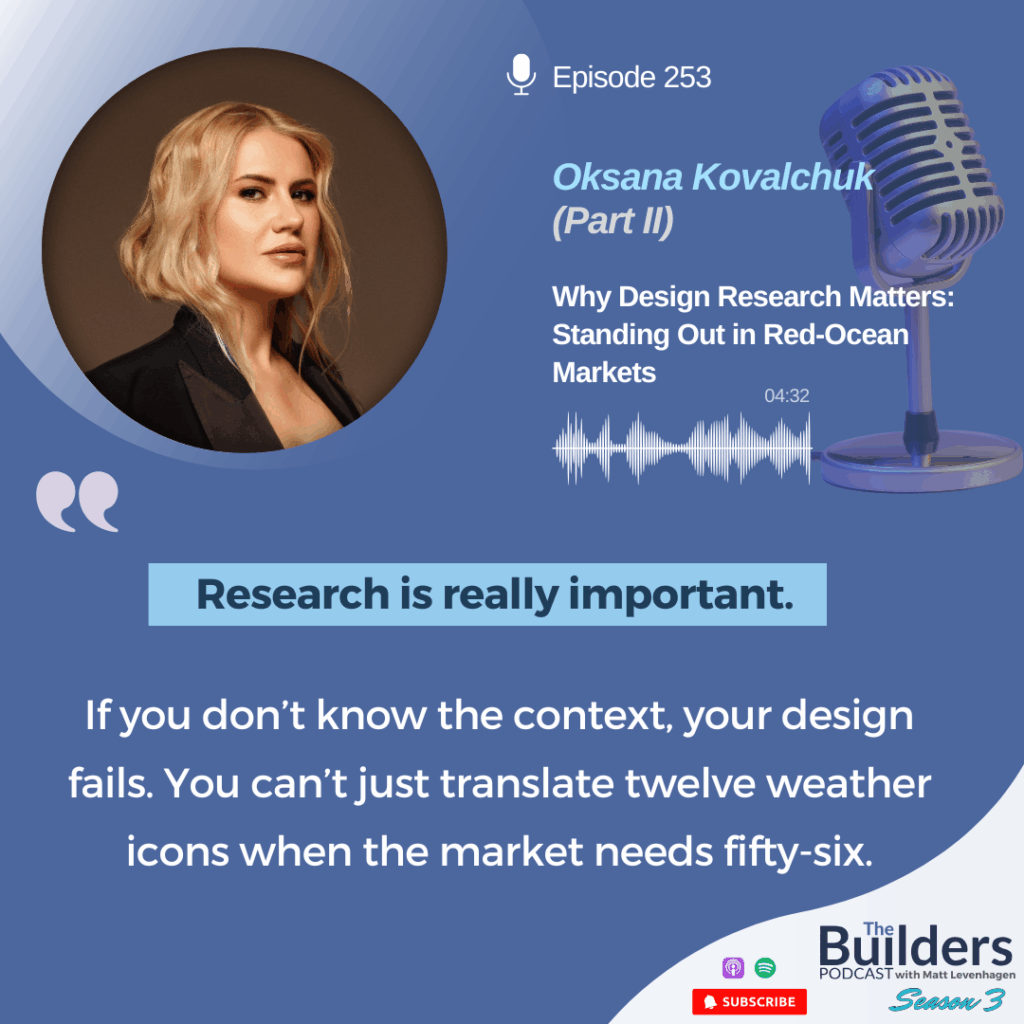
That focus surfaces again in one of her most striking stories—a weather app project derailed because the designer delivered twelve icons when the U.S. market required more than fifty. A perfect example of why design fails when the domain isn’t understood. Research isn’t extra. It’s the job. And in crowded red-ocean markets, where thousands of products look identical, understanding the space deeper than your competitors becomes your real advantage.
We explore why ideas are cheap, why competitors are “free data,” and why differentiation rarely comes from reinvention. It comes from clarity, context, and the willingness to understand how people actually use the things you’re building. This conversation pulls design back to first principles—grounded, real, and focused on what actually moves a product forward.
Key Takeaways:
- Research is the foundation of good design. Without understanding users and markets, design becomes guesswork.
- Competitors are a research resource, not a template. Study what works… don’t clone it.
- Constraints drive clarity. Early mobile dev shaped how Oksana strips design to what matters.
- Ideas are cheap—execution is market-tested reality. Research turns ideas into viable products.
- Differentiation doesn’t require novelty. It requires doing one thing better than the weakest competitor.
- Reality matters. Even big visions must align with physics, budgets, timelines, and user behavior.
Oksana Kovalchuk

I wrote my first line of code at 5 and started my first company at 16. Since then, I’ve been a CEO for over 5,578 days – long enough to learn that “being nice guy” doesn’t pay the bills, outcomes do. As a dev I’ve authored three apps that hit #1 in the US App Store, created the biggest @parseapp based product, and was featured by Mark Zuckerberg on stage at #F8.
Today, I build my UX Design agency and scale products with the same bias for action: ship, measure, iterate. I mentor founders and funds as a @techstars and other VCs, where my advice tends to be blunt: focus the roadmap, kill vanity metrics, and design around activation, retention, and revenue.
THE MEAT OF IT!
1. Rebuilding the Business After Hard Years
- Picking up after COVID and previous challenges
- Returning to craft with clarity and focus
2. The Roots of Oksana’s Design Philosophy
- Growing up in a family of developers
- Writing code at age five
- The leap from backend to mobile development
3. Mobile Development and the Birth of Her UX Perspective
- Designing for early iPhones with tight constraints
- Human Interface Guidelines and app store realities
- Why constraints shaped her approach to intentional design
4. Why Research Is the Cornerstone of Good UX
- The failed weather-app project story
- Understanding local contexts and cultural details
- Why “just copy competitors” destroys your brand
5. Competing in Red-Ocean Markets
- Why ideas are cheap and execution is everything
- Leveraging competitor insights without imitation
- Finding the one step that differentiates your product
6. Reality Checks, Bad Ideas, and Misunderstood Innovation
- The physics-defying app request story
- How to evaluate ideas against real-world constraints
7. First Principles of UX for Agencies and Product Teams
- Don’t reinvent the wheel
- Improve what exists
- Stay connected to real users and real markets
Check out these related Episodes:
- Episode 252: Oksana Kovalchuk – Rebuilding a 70-Person Agency After Collapse and Crisis
- Episode 251: Damon Darnall – Building Opportunity in a $30B Civilian Drone Industry on the Rise
- Episode 249: Nikita Vakhrushev – Building Smarter E-Commerce Growth Through Email, SMS, and Retention